Maintenance Law in Pakistan
پاکستان میں نان و نفقہ کا قانون — دفعہ 9 مسلم فیملی لاز آرڈیننس 1961Complete maintenance law Pakistan under Section 9 of Muslim Family Laws Ordinance 1961. Learn about wife maintenance, child support, iddat rights, and enforcement procedure. Updated with 2025-2026 case laws.
📚 Official Legal Resources: Pakistan Code (MFLO 1961) | Supreme Court | Lahore High Court
📑 Table of Contents
Introduction to Maintenance Law Pakistan
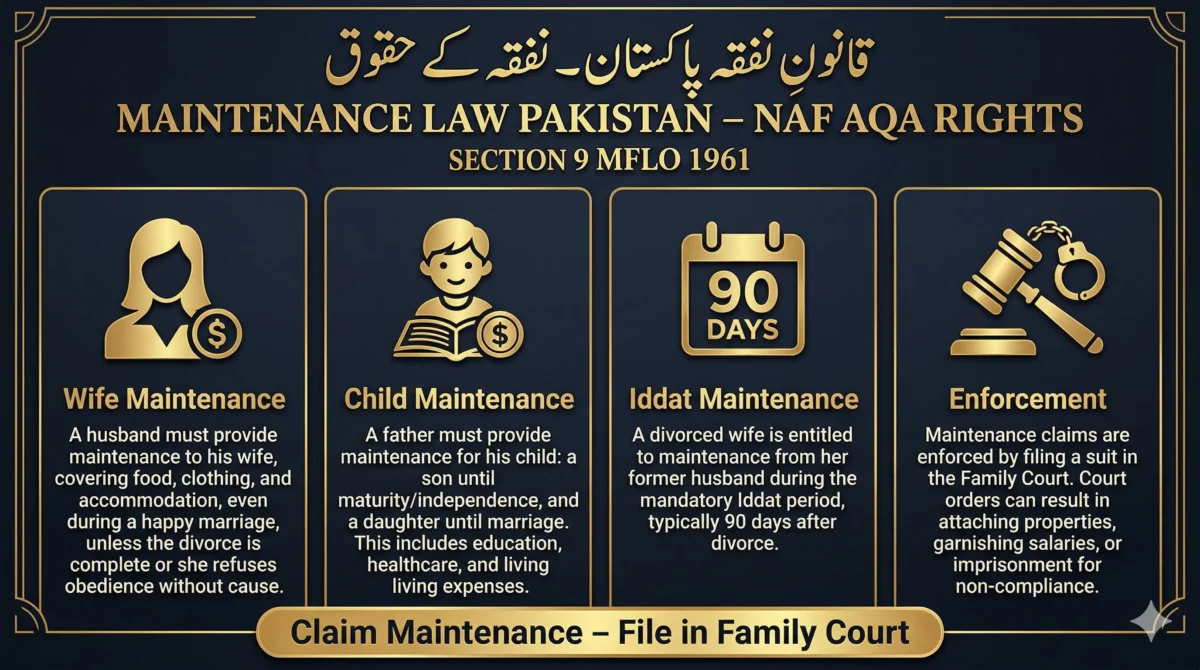
Maintenance law Pakistan (nafaqa) imposes a legal duty on husbands to provide financial support to their wives and children. The primary provision is Section 9 of the Muslim Family Laws Ordinance (MFLO) 1961. Maintenance includes food, clothing, shelter, medical care, and other reasonable necessities.
Under maintenance law Pakistan, a wife is entitled to maintenance during marriage and during the iddat period after divorce. Children are entitled to maintenance from their father until they are able to earn (sons) or until marriage (daughters).
Understanding maintenance law Pakistan is crucial for protecting the financial rights of women and children. This guide covers who can claim, how much, procedure, and enforcement. For a complete overview of all family laws, visit our Family Law in Pakistan – Complete Guide.
Legal Basis – Section 9 of MFLO 1961
Section 9 of MFLO 1961 is the cornerstone of maintenance law Pakistan. It empowers the Arbitration Council (or Family Court) to order maintenance for the wife and children. Key points:
- The husband must maintain his wife according to his means.
- The wife is entitled to maintenance even if she is living separately (if justified).
- Maintenance is payable from the date of application or from the date of refusal to maintain.
- Child maintenance continues until the child is able to earn (for sons) or until marriage (for daughters).
The Family Courts Act 1964 also applies, providing a speedy remedy (6 months timeline under Section 12A). Similar protections exist under khula proceedings and talaq cases.
Wife's Right to Maintenance (Nafaqa)
Under maintenance law Pakistan, a wife has the right to maintenance from her husband during the subsistence of marriage. Key principles:
- The wife is entitled to maintenance regardless of her own income (if husband's income is higher).
- The wife does not lose the right to maintenance if she is working, as long as she is obedient and lives with the husband.
- If the wife refuses to live with the husband without valid reason (nushuz), she may lose the right to maintenance.
- The wife can claim maintenance for past periods (up to 3 years) if the husband failed to pay.
The amount is determined based on husband's income, wife's needs, and the standard of living. For related rights, see our Nikah Registration guide.
Child Maintenance Under Maintenance Law Pakistan
Under maintenance law Pakistan, the father is obligated to maintain his children. The rules differ based on gender:
- Sons: Until the son is able to earn his own living (typically until age 18-21 or until employed).
- Daughters: Until marriage (even after age 18 if unmarried).
Child maintenance is separate from wife's maintenance. The amount is determined based on the father's income, number of children, and the child's needs (education, healthcare, etc.).
If the father fails to pay, the mother can file a maintenance suit on behalf of the children. For custody matters, see Child Custody Law.
Maintenance for Divorced Wife During Iddat
Under maintenance law Pakistan, a divorced wife is entitled to maintenance during the iddat period (90 days or 3 menstrual cycles). The husband must pay:
- Food, clothing, and shelter for the iddat period.
- Any unpaid haq mehr (dower).
After iddat, the wife is generally not entitled to further maintenance unless she is pregnant or unable to work. However, the Supreme Court has held that in certain cases, ongoing maintenance may be awarded if the wife is unable to support herself.
Maintenance for Parents and Other Relatives
Under maintenance law Pakistan, adult children are obligated to maintain their elderly parents if the parents are unable to support themselves. This is derived from Muslim personal law and is enforceable through Family Courts.
The court considers the child's financial capacity and the parent's reasonable needs. Daughters are also liable if they have sufficient means.
Quantum of Maintenance – How Much?
| Claimant | Typical Quantum | Basis |
|---|---|---|
| Wife (during marriage) | 20% to 30% of husband's income | Needs, husband's means, standard of living |
| Child (per child) | 10% to 15% of father's income | Number of children, child's needs |
| Divorced wife (iddat) | 。||
| Parents | 。
Courts have discretion to adjust based on circumstances. Income includes salary, business income, rental income, and other sources.
How to Claim Maintenance – Procedure
To claim maintenance under maintenance law Pakistan, follow these steps:
- Step 1: Send a legal notice to the husband demanding maintenance (optional but recommended).
- Step 2: Consult a family lawyer and gather evidence (marriage certificate, income proof, expenses).
- Step 3: File a maintenance petition in the Family Court under Section 9 MFLO or Section 488 CrPC (for child maintenance).
- Step 4: Court issues notice to the husband.
- Step 5: Both parties present evidence (income, needs).
- Step 6: Court passes an order for monthly maintenance, lump sum, or both.
- Step 7: If the husband fails to pay, file for execution/enforcement.
The Family Court is required to decide maintenance cases within 6 months under Section 12A of the Family Courts Act 1964. For detailed court procedures, visit Family Court Procedure guide.
Enforcement of Maintenance Orders
If the husband fails to pay court-ordered maintenance, the wife can seek enforcement under maintenance law Pakistan:
- Attachment of husband's salary (court orders employer to deduct and pay).
- Attachment of bank accounts or property.
- Arrest and civil imprisonment for willful default.
- Seizure of movable property.
The court can also order the husband to pay arrears (past due maintenance) with interest.
Failure to Pay Maintenance – Penalties
Under maintenance law Pakistan, willful failure to comply with a maintenance order is a serious offence. Penalties include:
- Civil imprisonment (up to 1 year).
- Fine and attachment of property.
- Contempt of court proceedings.
The court may also order the husband to pay maintenance from the date of application, not just from the date of order.
Landmark Case Laws on Maintenance Law Pakistan
| Case Citation | Key Ruling |
|---|---|
| PLD 2020 SC 345 | Working wife is still entitled to maintenance if husband's income is higher and she needs support. |
| 2024 SCMR 678 | Child maintenance includes education, healthcare, and reasonable extras. |
| 2025 MLD 234 | Maintenance during iddat is mandatory; failure to pay can lead to imprisonment. |
| 2023 PCrLJ 567 | Wife living separately due to husband's cruelty is still entitled to maintenance. |
For more case laws, visit our Case Laws Database and Legal Blog Pakistan.
Frequently Asked Questions on Maintenance Law Pakistan
نان و نفقہ سے متعلق اکثر پوچھے جانے والے سوالاتBiwi ko kitna kharcha mil sakta hai?
Typically 20-30% of husband's monthly income, depending on needs and standard of living.
Bachon ka kharcha kaise calculate hota hai?
Around 10-15% of father's income per child, plus education and medical expenses.
Kya kamati hui biwi bhi kharcha le sakti hai?
Yes, if husband's income is higher and her income is insufficient to meet her needs.
Kharcha na dene par kya kar sakte hain?
File a maintenance suit in Family Court. Court can attach salary or property.
Iddat ka kharcha kitne din ka hota hai?
90 days (or 3 menstrual cycles). Husband must pay maintenance during this period.
Kya walidain ka kharcha dena zaroori hai?
Yes, adult children must maintain elderly parents if parents cannot support themselves.
Chief Atta Ullah Baloch
Senior Family Law Expert | MK Law Associates ✓ 25+ years in High Courts & Sessions Courts of PakistanNeed to Claim Maintenance?
Our expert team can help you file a maintenance petition under Section 9 MFLO 1961 and enforce your rights.