Criminal Breach of Trust in Pakistan – PPC Section 405, FIR, Bail & Punishment (2026)
پاکستان میں خیانت کا قانون – تعزیرات پاکستان دفعہ 405 تا 409
Criminal breach of trust in Pakistan / خیانت کا قانون — complete guide covering legal definition under PPC Section 405, essential ingredients, FIR procedure, bail eligibility, punishment, compoundability, and expert defence strategies by Chief Atta Ullah Baloch, Senior Advocate High Court. Distinguished from Cheating Law and Fraud Law.
Criminal breach of trust in Pakistan: Defined under Section 405 PPC — entrustment of property + dishonest misappropriation or conversion. Unlike cheating (S.415), CBT starts with lawful possession followed by dishonest misuse. Section 406 PPC punishes CBT with imprisonment up to 7 years + fine (non-bailable). Section 409 PPC for public servants/bankers: up to life imprisonment. See Bail Laws for strategy.
⚡ Criminal Breach of Trust in Pakistan – Key Takeaways
1. Legal Definition Under Section 405 PPC
Criminal breach of trust in Pakistan is codified under Section 405 of the Pakistan Penal Code, 1860. The provision defines CBT as: whoever, being in any manner entrusted with property, or with any dominion over property, dishonestly misappropriates or converts to his own use that property, or dishonestly uses or disposes of that property in violation of any direction of law or any legal contract — commits "criminal breach of trust."
پاکستان میں خیانت کا قانون تعزیرات پاکستان کی دفعہ 405 کے تحت بیان کیا گیا ہے۔ اس کے مطابق، جب کوئی شخص کسی کے ذریعے اسے کوئی جائیداد یا مال سونپا جائے اور وہ اسے بے ایمانی سے اپنے استعمال میں لائے یا اسے ضائع کر دے، تو یہ "خیانت" کہلاتا ہے۔ اس جرم کا بنیادی عنصر امانت میں دی گئی جائیداد کا بے ایمانی سے غبن ہے — یعنی ملزم کے پاس جائیداد قانونی طور پر آئی، پھر اس نے بے ایمانی کی۔
⚖️ Section 405 PPC — Four Essential Ingredients: (1) Entrustment — the accused must have been entrusted with property or had dominion over it; (2) Dishonest misappropriation or conversion — not mere negligence but active dishonest dealing; (3) Violation of law or contract — the act must breach a legal direction or contractual obligation; (4) Wilful suffering — allowing another person to dishonestly deal with the property also constitutes CBT.
2. Essential Ingredients — CBT vs Cheating vs Fraud
🔑 CBT (S.405 PPC)
Entrustment comes first. Property was lawfully given to the accused — employee, agent, partner, trustee — who later dishonestly misappropriates it. Example: a cashier entrusted with company funds secretly transfers money to his personal account.
🎭 Cheating (S.415 PPC)
Deception comes first. The accused never had lawful possession — property was obtained through fraud or dishonest inducement. Example: selling a fake investment scheme and collecting money. See Cheating Law in Pakistan.
📄 Fraud (S.421-424 PPC)
False representation to creditors. Focuses on disposing or concealing property to prevent distribution among creditors. Example: transferring assets before declaring bankruptcy. See Fraud Law in Pakistan.
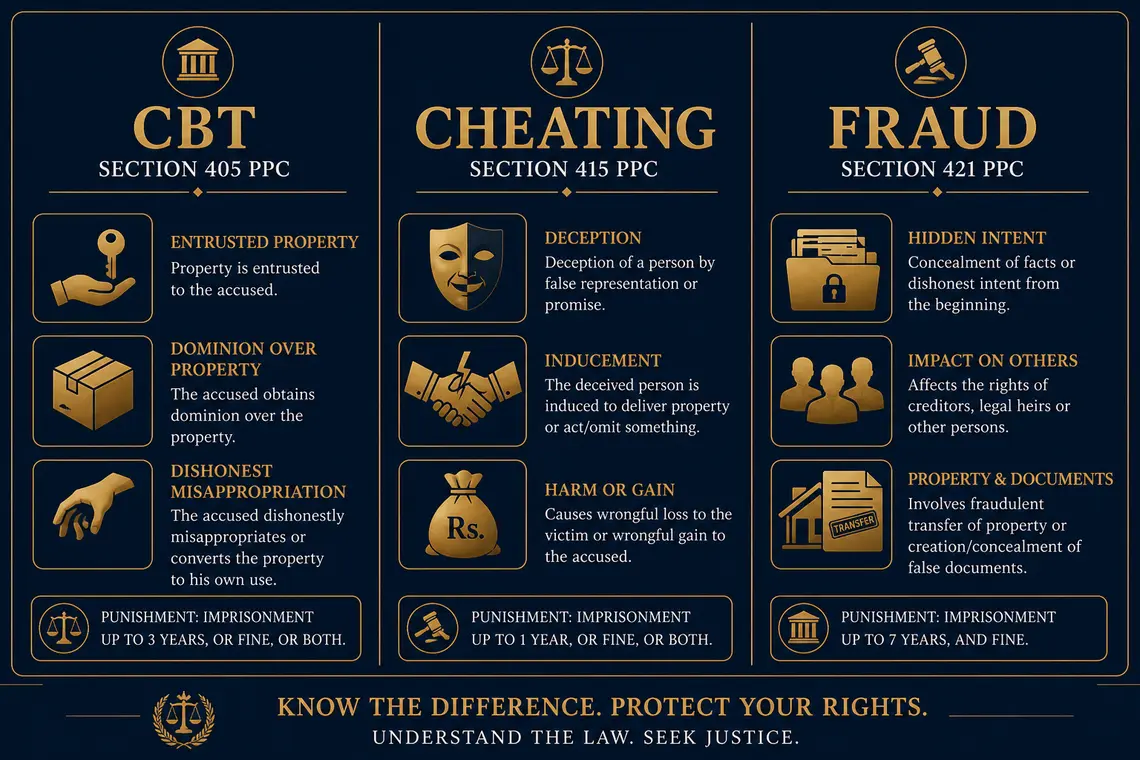
Criminal breach of trust in Pakistan / خیانت: CBT vs Cheating vs Fraud — three distinct PPC offences with different legal ingredients.
خیانت، دھوکہ دہی، اور فراڈ — تین مختلف PPC جرائم اور ان کے قانونی فرق۔ خیانت میں جائیداد پہلے قانونی طور پر سونپی جاتی ہے، دھوکہ دہی میں جائیداد دھوکے سے حاصل کی جاتی ہے، جبکہ فراڈ میں قرض داروں کو نقصان پہنچانے کے لیے جائیداد چھپائی یا منتقل کی جاتی ہے۔
3. PPC Sections Governing Criminal Breach of Trust
| Section | Offence | Punishment | Bailable? |
|---|---|---|---|
| 405 | Criminal Breach of Trust (Definition) | — | — |
| 406 | CBT by anyone | Up to 7 years + fine | ❌ Non-Bailable |
| 407 | CBT by carrier, wharfinger, warehouse keeper | Up to 7 years + fine | ❌ Non-Bailable |
| 408 | CBT by clerk or servant | Up to 7 years + fine | ❌ Non-Bailable |
| 409 | CBT by public servant, banker, merchant, agent | Up to 10 years / Life + fine | ❌ Non-Bailable |
For the distinction between CBT and other property offences, see Cheating Law in Pakistan and Fraud Law in Pakistan. Need professionally drafted legal documents? Our Virtual Clerk Service delivers court-ready CBT complaints and bail petitions. Explore free legal drafting templates & tools.
4. FIR and Investigation in CBT Cases
4.1 Is CBT Cognizable?
Yes. Sections 406-409 PPC are all cognizable offences. Police can register an FIR under Section 154 CrPC and arrest the accused without a warrant. See our complete FIR procedure in Pakistan guide.
4.2 Evidence Required
CBT cases are heavily document-dependent. Essential evidence includes: proof of entrustment (employment contract, partnership deed, trust deed, agency agreement), financial records showing the misappropriation (bank statements, audit reports, accounting entries), and communication records showing instructions given and violated.
📘 Key Strategy: The prosecution's first hurdle in every CBT case is proving entrustment. Without documentary evidence of entrustment, the case collapses — because the very first ingredient of Section 405 cannot be established.
ثبوت کی اہمیت: خیانت کے مقدمے میں سب سے اہم چیز یہ ثابت کرنا ہے کہ ملزم کو جائیداد سونپی گئی تھی۔ اگر یہ ثابت نہ ہو سکے تو مقدمہ شروع ہونے سے پہلے ختم ہو جاتا ہے۔ استغاثہ کو دستاویزی ثبوت کے ذریعے یہ دکھانا ہوتا ہے کہ جائیداد کب، کیسے، اور کن شرائط پر ملزم کے حوالے کی گئی تھی۔
📝 Need a Court-Ready CBT Complaint or Bail Petition?
Don't risk rejection from poorly drafted applications. Our Virtual Clerk Service delivers professionally formatted CBT complaints, bail petitions, and legal notices — ready within 24 hours. Also explore free templates & smart drafting tools.
5. Bail in CBT Cases
All CBT offences under Sections 406-409 are non-bailable. Bail is at the court's discretion. Courts typically consider: whether the accused has returned the property or compensated the loss, the amount involved and the accused's position of trust, strength of documentary evidence of entrustment, and whether the accused is likely to flee or tamper with evidence.
⚠️ Bail Strategy: The strongest ground for bail in CBT cases is demonstrating that the dispute is essentially civil — not criminal. If the accused can show that the property was retained due to a genuine dispute over accounts, a claim of right, or a civil disagreement about contractual obligations, the court may grant bail. For detailed guidance, see Bail Laws in Pakistan and How to Get Bail.
6. Common Defences in CBT Cases
Defence 1: No Entrustment. If the accused can prove that property was never formally entrusted — it was a gift, a personal loan, or a joint asset — the very foundation of Section 405 collapses.
Defence 2: Civil Dispute, Not Criminal. If the matter is essentially an accounting dispute between business partners, an employer-employee salary disagreement, or a contractual settlement issue, it belongs in civil court.
Defence 3: Genuine Claim of Right. If the accused believed in good faith they had a legal right to retain or use the property — for example, an employee retaining salary arrears — this negates "dishonesty."
Defence 4: No Dishonest Intention. Mere failure to return property on time, without evidence of dishonest misappropriation, does not constitute CBT. Negligence is not dishonesty.
دفاعی حکمت عملی: خیانت کے مقدمات میں سب سے کامیاب دفاع یہ ثابت کرنا ہے کہ جائیداد کبھی باضابطہ طور پر امانت میں نہیں دی گئی، یا یہ کہ معاملہ فوجداری کی بجائے سول نوعیت کا ہے۔ کاروباری شراکت داروں کے درمیان حساب کتاب کے تنازعات، ملازم اور آجر کے درمیان تنخواہ کے جھگڑے، اور خاندانی جائیداد کے معاملات — یہ سب عام طور پر سول عدالتوں میں حل ہونے چاہئیں، فوجداری عدالتوں میں نہیں۔
7. Compoundability and Settlement
CBT is a compoundable offence under Section 345 CrPC with the permission of the court. The victim (the person who entrusted the property) can accept compensation and forgive the accused, leading to acquittal. However, for CBT by public servants under Section 409, the court scrutinises compromises more strictly — given the public interest element.
خیانت قابل صلح جرم ہے۔ جس شخص نے جائیداد سونپی تھی، وہ معاوضہ قبول کر کے ملزم کو معاف کر سکتا ہے۔ عدالت کی منظوری کے بعد ملزم کو بری کیا جا سکتا ہے۔ تاہم، سرکاری ملازمین (دفعہ 409) کے معاملات میں عدالت صلح کو زیادہ سختی سے جانچتی ہے۔
8. Frequently Asked Questions (FAQs)

Chief Atta Ullah Baloch
Senior Advocate High Court | MK Legal Hub | 35+ Years Experience
"Criminal breach of trust in Pakistan is one of the most frequently misused provisions — especially in business and employment disputes. I have seen countless cases where a genuine commercial disagreement was converted into a criminal CBT case to pressure the other party. The key is always entrustment. If there was no formal entrustment — if the property was jointly owned, if it was a gift, or if the accused had a legitimate claim of right — then there is no CBT. Always demand documentary proof of entrustment, and never let a civil dispute be prosecuted as a crime."
Need Legal Help in a CBT Case?
خیانت کے مقدمے میں قانونی مدد چاہیے؟