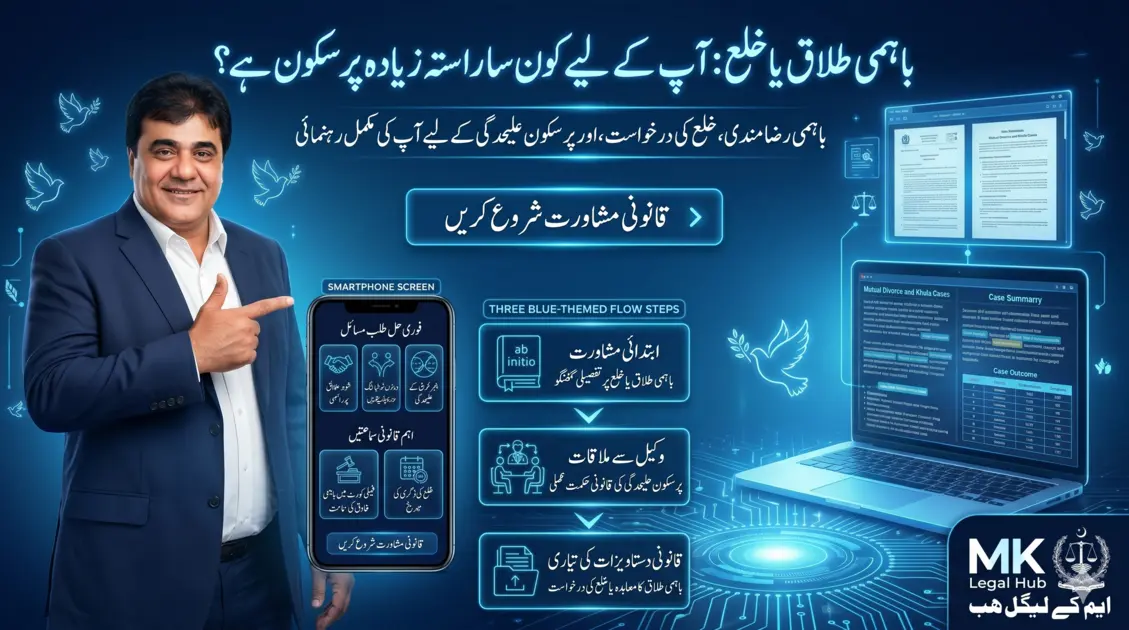
Mutual Divorce vs Khula in Pakistan: Which is the Peaceful Path? Complete Comparison (2026)
You want a separation that is dignified. You want to avoid the fighting, the bitterness, and the emotional exhaustion of a contested divorce. You have heard about Mutual Divorce and Khula, but you are not sure which path is right for your situation. This guide explains the difference between Mutual Divorce vs Khula in Pakistan, which is faster, which is more peaceful, what the legal requirements are, and what mistakes to avoid. Written with the calm and dignity that your situation deserves.
Mutual Divorce vs Khula in Pakistan: Quick Legal Answer
Mutual Divorce is when both husband and wife agree to separate and jointly file for divorce. It is the fastest and most peaceful path. Khula is when the wife initiates the separation through the Family Court, even if the husband does not consent. In mutual divorce vs khula in Pakistan: mutual divorce requires cooperation and takes 1-3 months. Khula is the remedy when cooperation is not possible and takes 3-6 months. In mutual divorce, both parties agree on terms including Haq Mehr, maintenance, and children. In khula, the wife typically returns her Haq Mehr and the court dissolves the marriage. Both are legally valid.
1. Side-by-Side Comparison Table: Mutual Divorce vs Khula in Pakistan
| Factor | Mutual Divorce | Khula |
|---|---|---|
| Who Initiates | Both husband and wife jointly | Wife alone |
| Husband's Consent | Required | Not required |
| Legal Basis | Muslim Family Laws Ordinance 1961 | Dissolution of Muslim Marriages Act 1939 |
| Where Filed | Family Court (joint application) | Family Court (wife's suit) |
| Haq Mehr | Negotiated – wife may keep it | Usually returned to husband |
| Procedure | Joint application, single hearing, decree | Wife's suit, reconciliation attempts, evidence, decree |
| Timeline | 1 to 3 months | 3 to 6 months (longer if contested) |
| Cost | Lower – single joint lawyer | Moderate – wife's lawyer + court fees |
| Reconciliation | Not mandatory – both already agree | Mandatory by Family Court |
| Conflict Level | Very low – both parties agree | Can be high if husband opposes |
| Best For | Couples who want to separate peacefully | Wives whose husbands refuse talaq or cooperation |
| Final Result | Marriage dissolved, decree issued | Marriage dissolved, decree issued |

2. What is Mutual Divorce in Pakistan? Understanding Mutual Divorce vs Khula
Mutual divorce is the simplest and most peaceful form of divorce in Pakistani family law. It occurs when both husband and wife agree that the marriage has broken down irretrievably and they jointly apply to the Family Court for dissolution. When considering mutual divorce vs khula in Pakistan, mutual divorce is always the preferred path if cooperation exists.
✅ Joint Application
Both spouses sign a joint application and appear before the Family Court together. There is no fighting, no blame, and no lengthy litigation. Read: Mutual Divorce Complete Guide.
✅ Agreed Terms
The couple agrees on all terms: Haq Mehr, maintenance (past and future), child custody, dowry articles, and any other financial matters. This agreement is submitted to the court.
✅ Single Hearing
Typically, the court holds one hearing. If the judge is satisfied that both parties are acting voluntarily and the terms are fair, a decree is issued. The entire process can be completed in 1-3 months.
✅ Most Dignified Path
Because both parties cooperate, mutual divorce preserves dignity and often allows the couple to maintain a functional relationship for co-parenting after divorce.
باہمی طلاق کیا ہے؟ باہمی طلاق پاکستانی فیملی لاء میں سب سے آسان اور پرسکون راستہ ہے۔ میاں بیوی دونوں مشترکہ طور پر فیملی کورٹ میں درخواست دیتے ہیں، شرائط طے کرتے ہیں، اور عام طور پر ایک ہی سماعت میں ڈگری مل جاتی ہے۔ اس میں 1-3 ماہ لگتے ہیں۔
3. What is Khula in Pakistan? Mutual Divorce vs Khula Explained
Khula is the wife's right to seek dissolution of her marriage through the Family Court. It is the remedy when the husband refuses to give talaq or when mutual divorce is not possible. In the context of mutual divorce vs khula in Pakistan, khula is the path when cooperation is absent.
✅ Wife Initiates
The wife files a suit for dissolution of marriage. She does not need the husband's permission or consent. This is the most powerful feature of khula. Read: Khula Procedure Complete Guide.
✅ No Husband's Consent Required
The court can dissolve the marriage even if the husband strongly opposes it. The husband cannot permanently block a khula.
✅ Return of Haq Mehr
In most khula cases, the wife returns her Haq Mehr to the husband. This is based on the Islamic principle of dissolution in exchange for consideration.
✅ Reconciliation Attempt
The Family Court must attempt reconciliation before granting a decree. This is mandatory. Timeline: 3-6 months, longer if contested.
خلع کیا ہے؟ خلع بیوی کا حق ہے کہ وہ فیملی کورٹ کے ذریعے شادی ختم کرائے، چاہے شوہر راضی نہ ہو۔ بیوی کو شوہر کی اجازت کی ضرورت نہیں۔ عدالت شوہر کی مخالفت کے باوجود نکاح ختم کر سکتی ہے۔ عام طور پر حق مہر واپس کرنا پڑتا ہے اور اس میں 3-6 ماہ لگتے ہیں۔
4. Which is Faster and Better for Your Situation?
Mutual divorce is faster. The entire process can be completed in 1-3 months with a single hearing. Khula takes 3-6 months, and longer if contested. This is a key difference in mutual divorce vs khula in Pakistan.
🌟 Choose Mutual Divorce If
Your husband is willing to cooperate and agrees to separate. You want the fastest and least expensive path. You want to negotiate terms including keeping your Haq Mehr. You want to avoid court battles and emotional stress. You and your husband can agree on child custody and finances.
🌟 Choose Khula If
Your husband refuses to give talaq or cooperate. Your husband is absent, missing, or has abandoned you. You want to initiate the separation yourself with full legal protection. You are willing to return your Haq Mehr. You are prepared for a court process that takes several months.
After separation, also consider: Maintenance rights after divorce and Child custody arrangements.
کون سا بہتر ہے؟ اگر شوہر راضی ہے تو باہمی طلاق بہتر ہے: تیز، سستی، پرسکون۔ اگر شوہر انکار کر رہا ہے تو خلع آپ کا حق ہے۔ دونوں صورتوں میں کسی تجربہ کار فیملی وکیل سے مشورہ کریں۔
5. Common Mistakes Women Make in Mutual Divorce vs Khula
❌ Waiting Too Long When Husband is Cooperative
If your husband has agreed to a separation, do not delay. File for mutual divorce while the cooperation exists. Circumstances change.
❌ Filing Khula When Mutual Divorce is Possible
If your husband is willing to cooperate, khula wastes time and money. Mutual divorce is faster, cheaper, and less stressful.
❌ Not Agreeing on Child Custody Beforehand
Even in mutual divorce, children are the most sensitive issue. Agree on custody and visitation before filing the joint application. Read: Child Custody Law.
❌ Not Putting Financial Terms in Writing
Verbal promises are not enforceable. All financial terms must be in the written agreement submitted to the court.
❌ Thinking Mutual Divorce Means Losing Your Rights
Mutual divorce does not mean you give up your rights. You can negotiate maintenance, child custody, and keep your Haq Mehr.
عام غلطیاں: شوہر کے راضی ہونے پر تاخیر، باہمی طلاق ممکن ہونے پر خلع دائر کرنا، بچوں کی کسٹڈی پہلے سے طے نہ کرنا، مالی شرائط تحریر میں نہ دینا، اور یہ سمجھنا کہ باہمی طلاق میں حقوق ختم ہو جاتے ہیں۔
6. باہمی طلاق یا خلع: عام پاکستانی خاتون کے لیے اردو راہنما
جب شادی میں مزید رہنا ممکن نہ رہے تو علیحدگی کے دو راستے ہیں: باہمی طلاق اور خلع۔
باہمی طلاق
یہ سب سے پرسکون راستہ ہے۔ جب آپ اور شوہر دونوں علیحدگی پر راضی ہوں تو مشترکہ طور پر فیملی کورٹ میں درخواست دیں۔ شرائط طے کریں، اور عام طور پر ایک ہی سماعت میں ڈگری مل جاتی ہے۔ 1-3 ماہ لگتے ہیں۔
خلع
جب شوہر تعاون نہ کرے تو خلع بیوی کا قانونی حق ہے۔ فیملی کورٹ شوہر کی مرضی کے بغیر نکاح ختم کر سکتی ہے۔ 3-6 ماہ لگتے ہیں۔
کون سا بہتر ہے؟
- اگر شوہر راضی ہے تو باہمی طلاق: تیز، سستی، پرسکون
- اگر شوہر انکار کر رہا ہے تو خلع: قانون آپ کے ساتھ ہے
- دونوں راستے قانونی اور باوقار ہیں
7. Frequently Asked Questions: Mutual Divorce vs Khula in Pakistan
Q1: Can we file for mutual divorce if we have children? +
Yes. Child custody and visitation arrangements are part of the mutual agreement. The court will approve the arrangement if it serves the children's welfare.
Q2: Is mutual divorce valid in Islam? +
Yes. Mutual consent divorce (khula or mubarat) is recognized in Islamic law. When both parties agree, the divorce is valid.
Q3: How long does mutual divorce take in Pakistan? +
Typically 1-3 months. If both parties appear and the paperwork is complete, the decree can be issued in a single hearing.
Q4: Can I convert my khula case to mutual divorce? +
Yes. If the husband agrees to cooperate during the khula proceedings, the case can be converted to mutual divorce, saving time and expense.
Q5: Do I need a lawyer for mutual divorce? +
While both parties can file jointly, having a lawyer ensures the agreement is fair and all legal requirements are met. A single lawyer can represent both parties.
Q6: باہمی طلاق اور خلع میں کیا فرق ہے؟ +
Q7: کیا باہمی طلاق میں حق مہر واپس کرنا پڑتا ہے؟ +
Q8: کیا خلع بغیر شوہر کی رضامندی ممکن ہے؟ +

Chief Atta Ullah Baloch
Senior Advocate High Court · 25+ Years · Quetta & Mastung
"In my 25 years of practice in Family Courts across Balochistan, I have seen one truth repeat itself: a marriage that ends with dignity leaves fewer scars than one that ends with conflict. If your husband is willing to cooperate, mutual divorce is the path I recommend to nearly every client. It saves time, money, and emotional energy. However, if your husband refuses to cooperate, do not despair. Khula is your legal right. The court can and will release you from a broken marriage, even if your husband opposes it. The law is on your side."

Want a Peaceful Separation? Get Expert Legal Guidance
Whether you choose mutual divorce or khula, the right legal strategy can make all the difference. Chief Atta Ullah Baloch has helped countless families in Balochistan navigate separation with dignity.
📱 WhatsApp: 03414834719 📧 Schedule Consultation