Protection Order in Pakistan
پاکستان میں تحفظ کا حکم — کیسے حاصل کریں اور مکمل قانونی طریقہ کارComplete guide to protection order in Pakistan under domestic violence laws. Learn about eligibility, application process, court procedure, and penalties for violation.
📌 Key Takeaways – Protection Order in Pakistan
- What is a protection order? A court order that prohibits an abuser from committing further domestic violence.
- Who can apply? Any aggrieved person including wife, children, and any relative living in a shared household.
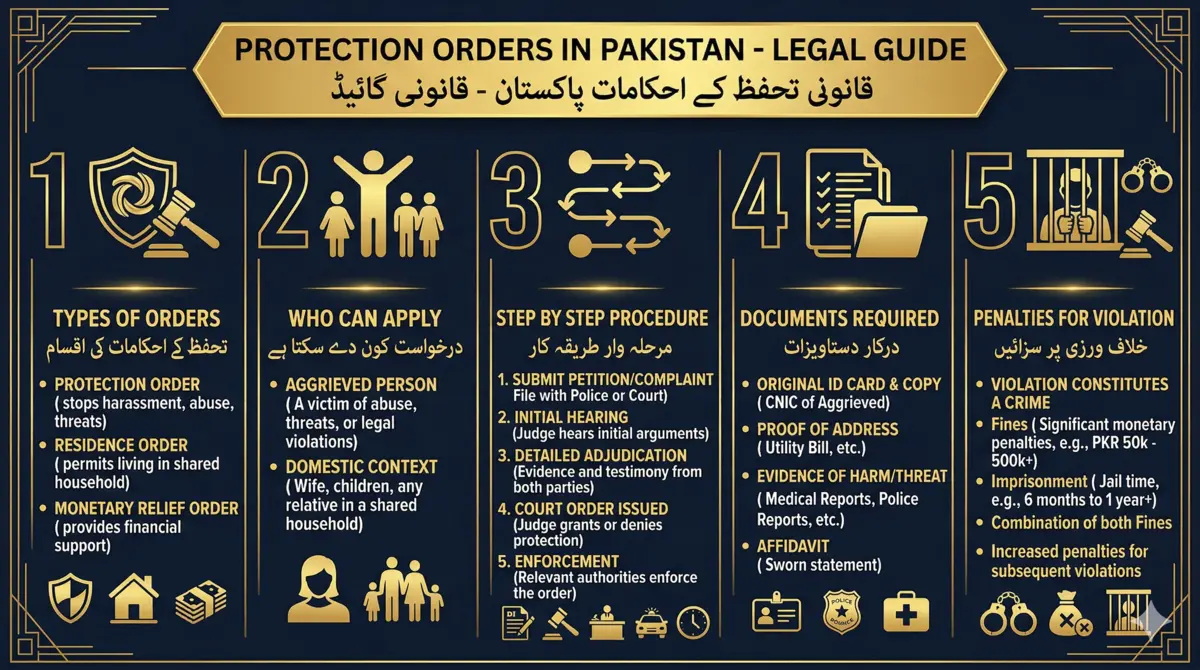
- Types of orders: Protection Order (stops harassment), Residence Order (right to stay in shared home), Monetary Relief Order (financial support).
- How long does it take? Interim order within 24-48 hours; final order within 30-60 days.
- Penalty for violation: Fines (PKR 50,000 to 500,000+) and imprisonment (6 months to 1 year+).
- Where to apply? Family Court or Magistrate Court having jurisdiction.
A protection order in Pakistan is a court order that prohibits an abuser from committing domestic violence. Key features include:
- Interim protection order: Issued within 24-48 hours for urgent cases
- Final protection order: Issued after full hearing, lasts 6 months to 2 years
- Residence order: Allows victim to stay in shared home
- Monetary relief order: Court orders abuser to pay financial compensation
Legal basis: Provincial Domestic Violence Acts and Federal DV Act 2026. Violation of protection order is a criminal offense with imprisonment up to 1 year and fines up to PKR 500,000.
📑 Table of Contents
What is a Protection Order? (Short Answer)
A protection order in Pakistan is a legal document issued by a court that prohibits an abuser from committing domestic violence against the victim. It can also grant the victim the right to stay in the shared residence and order monetary compensation.
Under domestic violence laws in Pakistan, protection orders are available under provincial acts (Punjab 2016, Sindh 2013, KPK 2021, Balochistan 2014) and the Federal DV Act 2026 for Islamabad.
The purpose of a protection order is to prevent further harm, provide immediate safety, and give the victim legal recourse if the order is violated. It is one of the most powerful tools available to domestic violence victims in Pakistan.
Legal Basis for Protection Orders in Pakistan
The legal authority for a protection order in Pakistan comes from the following laws:
- Punjab Protection of Women Against Violence Act 2016 – Sections 12-17 provide for protection orders, residence orders, and monetary relief. The Act applies to all districts of Punjab province.
- Sindh Domestic Violence (Prevention and Protection) Act 2013 – Sections 10-15 cover protection orders, residence orders, and compensation. This was the first provincial law on domestic violence in Pakistan.
- Khyber Pakhtunkhwa Domestic Violence Against Women Act 2021 – Sections 11-16 provide comprehensive protection order mechanisms. The Act was passed after extensive consultation with women's rights organizations.
- Balochistan Domestic Violence (Prevention and Protection) Act 2014 – Sections 9-14 establish the framework for protection orders in the province.
- Federal Domestic Violence (Prevention and Protection) Act 2026 – Sections 8-13 apply to the Islamabad Capital Territory. This is the most recent legislation, signed into law by President Asif Ali Zardari on January 26, 2026.
- Family Courts Act 1964 – Provides the procedural framework for enforcement of protection orders.
- Pakistan Penal Code (PPC) 1860 – Sections 332-338 (hurt), 337 (assault), and 509 (insulting modesty) provide additional criminal remedies.
Under these laws, the court has the power to issue protection orders, residence orders, and monetary compensation orders to protect victims of domestic violence. The courts are required to act promptly, with interim orders available within 24-48 hours in urgent cases.
Who Can Apply for a Protection Order in Pakistan?
The following persons can apply for a protection order in Pakistan:
- Any woman who is a victim of domestic violence (wife, mother, sister, daughter, or any female family member).
- Any man who is a victim of domestic violence (under some provincial laws, men can also apply for protection orders).
- Children – applications can be filed by parents, guardians, or social welfare officers on their behalf.
- Any family member living in a domestic relationship, including elderly parents, siblings, and other relatives.
- Transgender persons (explicitly protected under the Federal DV Act 2026).
- On behalf of the victim: Protection Officers, Women Protection Officers, social welfare officers, or any person with the victim's written consent can also file an application.
- Neighbors or concerned citizens can report domestic violence to the Protection Committee, which can then initiate proceedings.
The application can be filed against a spouse, ex-spouse, family member, or any person in a domestic relationship with the victim. There is no requirement that the victim and abuser live together – former spouses and separated family members are also covered.
Types of Protection Orders Available
Under protection order in Pakistan laws, courts can issue three main types of orders:
| Type | Purpose | What It Does | Duration |
|---|---|---|---|
| Protection Order | 。|||
| Residence Order | 。|||
| Monetary Relief Order | 。|||
In addition to these, courts can also issue:
- Interim Protection Order: Issued immediately (within 24-48 hours) without notice to the respondent in urgent cases. Valid for 7-15 days until the final hearing.
- Custody Order: Temporary custody of children may be granted to the victim.
- Counseling Order: Court may order the respondent to attend counseling sessions.
Step by Step Procedure to Obtain a Protection Order in Pakistan
File a written petition or complaint with the Police or directly with the Family Court/Magistrate Court. The complaint should detail the acts of domestic violence, including dates, times, and nature of abuse. You can also file through a Protection Officer or Women Protection Officer free of cost.
The court holds an initial hearing where the judge hears preliminary arguments. If the court finds a prima facie case of domestic violence, it may issue an interim protection order immediately (within 24-48 hours). The interim order remains valid until the final hearing.
The court issues formal notice to the respondent (abuser) to appear on a specified date. The notice is served through the police or court bailiff within 7 days. The respondent must file a written statement (reply) within 30 days.
A full hearing is conducted where both parties present evidence. The victim may present medical reports, witness statements, photographs, threatening messages, call recordings, and other documentary evidence. Both parties can cross-examine witnesses.
After hearing both sides and reviewing all evidence, the judge issues a final order. The court may grant or deny the protection order. If granted, the order specifies the duration, conditions, and any additional relief (residence order, monetary relief, custody order).
The protection order is forwarded to the relevant authorities (police, Protection Committee) for enforcement. The victim receives a certified copy of the order. If the abuser violates the order, the victim can immediately report to the police for arrest without warrant.
Documents Required for Protection Order Application
When applying for a protection order in Pakistan, gather these essential documents:
| Document Type | Description | Why It's Important |
|---|---|---|
| Original ID Card & Copy | CNIC of the aggrieved person (victim)。 | |
| Proof of Address | Utility bill (electricity, gas, water), rent agreement, or any official document showing residence。 | |
| Evidence of Harm / Threat | Medical reports (from government hospital), photographs of injuries, police reports (FIR), threatening messages (SMS, WhatsApp), call recordings, witness statements。 | |
| Affidavit | Sworn written statement signed by the victim, witnessed by a notary public or oath commissioner。 | |
| Proof of Relationship | Nikahnama (marriage certificate), family registration certificate, children's birth certificates。 | |
| FIR Copy (if registered) | Certified copy of First Information Report filed at police station。 |
Additional documents that may be helpful:
- Diary or journal documenting incidents of abuse with dates and times
- Witness affidavits from neighbors, family members, or colleagues
- School records showing child's attendance (in custody matters)
- Financial documents showing dependency (for monetary relief orders)
What Happens After You Apply? (Detailed Court Procedure)
After filing an application for a protection order in Pakistan, the following court procedure occurs:
- Day 1-2 (Urgent Cases): The court reviews the application immediately. If the judge is satisfied that there is an imminent threat of domestic violence, an interim protection order is issued within 24-48 hours. This order is ex-parte (without notice to the respondent) and is valid for 7-15 days or until the final hearing.
- Within 7 days: The court issues formal notice to the respondent (abuser) to appear on a specified date. The notice is served through police or court bailiff. The notice informs the respondent of the allegations and the date of the final hearing.
- Within 30 days: The respondent files a written statement (reply) to the application. The written statement must address each allegation made by the victim. Failure to file a written statement may result in the court proceeding ex-parte (in the respondent's absence).
- 30-60 days: Full hearing with evidence from both sides. The victim presents her evidence first (medical reports, photographs, witness statements). The respondent may cross-examine the victim's witnesses. The respondent then presents his defense, and the victim may cross-examine his witnesses.
- After hearing: The court issues a final protection order, residence order, and/or monetary compensation order. The order specifies the duration (typically 6 months to 2 years), conditions, and consequences of violation. The order is signed and sealed by the judge.
Under Section 12A of the Family Courts Act 1964, the court should decide the matter within 6 months from the date of filing. If the court fails to decide within this period, it must record reasons for the delay.
How Long Does a Protection Order Last?
The duration of a protection order in Pakistan depends on the type of order and the circumstances of the case:
| Type of Order | Typical Duration | Renewable? | Notes |
|---|---|---|---|
| Interim Protection Order | 7 to 15 days | Yes (if final hearing is delayed)。 | |
| Final Protection Order | 6 months to 2 years | Yes。 | |
| Residence Order | Same as protection order | Yes。 | Monetary Relief Order | One-time payment or periodic。 |
Renewal Process: The victim can apply for renewal of the protection order before it expires. The court may extend the order if it finds that the threat of violence continues. There is no limit on the number of renewals. The renewal application should be filed at least 30 days before the expiration date.
Modification: Either party can apply to the court to modify the protection order if circumstances change (e.g., the abuser completes anger management counseling, or the victim moves to a new location).
What Happens If the Abuser Violates the Protection Order?
Violation of a protection order in Pakistan is a serious criminal offense. The consequences include:
| Violation | Penalty Under Law | Additional Consequences |
|---|---|---|
| First violation | 。||
| Subsequent violations | 。||
| Violation causing hurt | 。||
| Violation of residence order | 。
What the victim should do if the order is violated:
- Call the police immediately (emergency number 15) and report the violation.
- Provide the police with a copy of the protection order.
- File a complaint with the Protection Committee or Women Protection Officer.
- File a contempt of court petition in the same court that issued the protection order.
- Document the violation (take photos, record video, save messages, get witness statements).
Police duties: Under the provincial DV Acts, police are duty-bound to arrest the abuser without warrant if they have reason to believe that a protection order has been violated. Failure to act can result in disciplinary action against the police officer.
Protection Orders in Different Provinces
The process for obtaining a protection order in Pakistan varies slightly by province. Below is a comprehensive comparison:
| Province | Law Name & Year | Applying Court | Protection Officer Available? | Key Features |
|---|---|---|---|---|
| Punjab | 。||||
| Sindh | 。||||
| Khyber Pakhtunkhwa | 。||||
| Balochistan | 。||||
| Islamabad (Federal) | 。
Important Note: Even if your province does not have a comprehensive DV Act, you can still seek protection orders under the Family Courts Act 1964 and Pakistan Penal Code. Consult a local lawyer for guidance specific to your district.
Landmark Case Laws on Protection Orders in Pakistan
| Case Citation | Court | Year | Key Ruling |
|---|---|---|---|
| PLD 2015 SC 234 | 。|||
| 2024 SCMR 567 | 。|||
| 2025 MLD 123 | 。|||
| 2023 PCrLJ 789 | 。
These judgments have significantly strengthened the enforcement of protection orders across Pakistan. Courts are now more proactive in issuing interim orders and penalizing violations.
Frequently Asked Questions on Protection Order in Pakistan
Q1: Protection order in Pakistan kitne din mein milta hai?
Answer: Interim protection order can be issued within 24-48 hours in urgent cases. Final protection order takes 30-60 days after full hearing. Under the Punjab Act, the court must decide interim applications within 7 days.
Q2: Kya protection order ke liye lawyer zaroori hai?
Answer: Not mandatory, but highly recommended. You can file through a Protection Officer or Women Protection Officer for free assistance. Legal aid is also available through Protection Committees and NGOs.
Q3: Kya protection order online apply kar sakte hain?
Answer: Currently, most courts require physical filing. However, some districts in Punjab have introduced e-filing systems through the Punjab Information Technology Board (PITB). Consult your local Family Court or check the official court website.
Q4: Protection order ki khilaf warzi par kya penalty hai?
Answer: For first violation: imprisonment up to 6 months and fine of PKR 50,000-100,000. For subsequent violations: imprisonment up to 1 year and fine of PKR 100,000-500,000. Under the Federal DV Act 2026, minimum compensation of PKR 20,000 is also mandatory.
Q5: Kya protection order ke baad abuser ghar aa sakta hai?
Answer: No. If the court issues a residence order, the abuser is prohibited from entering the shared household. The police have the authority to remove the abuser if he attempts to enter. Violation of a residence order carries additional penalties.
Q6: Kya protection order ke liye fee lagti hai?
Answer: Court fees are nominal (typically PKR 50-200). If you cannot afford even this, you can apply for fee exemption through the Protection Officer or legal aid services.
Q7: Kya protection order men and children ke liye bhi hai?
Answer: Yes. While most laws focus on women, men and children can also apply for protection orders under certain provincial laws. The Federal DV Act 2026 explicitly protects "any aggrieved person" regardless of gender. Children can apply through parents or guardians.

Chief Atta Ullah Baloch
Senior Family Law Expert | MK Law Associates, Mastung, Pakistan ✓ 25+ years in High Courts & Sessions Courts of PakistanComplete Family Law Resources from MK Legal Hub
Need a Protection Order? Get Legal Help Now
Our expert lawyers can help you file a protection order application, gather evidence, and represent you in court. Confidential and immediate assistance available. Call our helpline or WhatsApp us now.